Flexible molecules
Modelling of internal degrees of freedom, usual techniques:
Bond distances
Atoms linked by a chemical bond (stretching):

However, this internal coordinates are very often kept constrained (fixed bond distances)
Bond Angles
Bond sequence: 1-2-3:
Bond Angle:

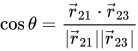
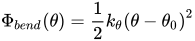
Two typical forms are used to model the bending potential:

Dihedral angles. Internal Rotation
Bond sequence: 1-2-3-4 Dihedral angle () definition:

Consider the following vectors:
- ; Unit vector in the direction of the 2-3 bond
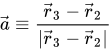
- ; normalized component of ortogonal to
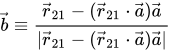


- ; normalized component of ortogonal to
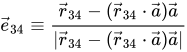

- Failed to parse (Conversion error. Server ("https://wikimedia.org/api/rest_") reported: "Cannot get mml. Server problem."): {\displaystyle {\vec {c}}={\vec {a}}\times {\vec {b}}}
- Failed to parse (Conversion error. Server ("https://wikimedia.org/api/rest_") reported: "Cannot get mml. Server problem."): {\displaystyle e_{34}=(\cos \phi ){\vec {a}}+(\sin \phi ){\vec {c}}}
For molecules with internal rotation degrees of freedom (e.g. n-alkanes), a torsional potential is usually modelled as:
- Failed to parse (Conversion error. Server ("https://wikimedia.org/api/rest_") reported: "Cannot get mml. Server problem."): {\displaystyle \Phi _{tors}\left(\phi \right)=\sum _{i=0}^{n}a_{i}\left(\cos \phi \right)^{i}}
or
- Failed to parse (Conversion error. Server ("https://wikimedia.org/api/rest_") reported: "Cannot get mml. Server problem."): {\displaystyle \Phi _{tors}\left(\phi \right)=\sum _{i=0}^{n}b_{i}\cos \left(i\phi \right)}
Van der Waals intramolecular interactions
For pairs of atoms (or sites) which are separated by a certain number of chemical bonds:
Pair interactions similar to the typical intermolecular potentials are frequently used (e.g. Lennard-Jones potentials)